
How we work Collaboration in action: connecting science, data, and families
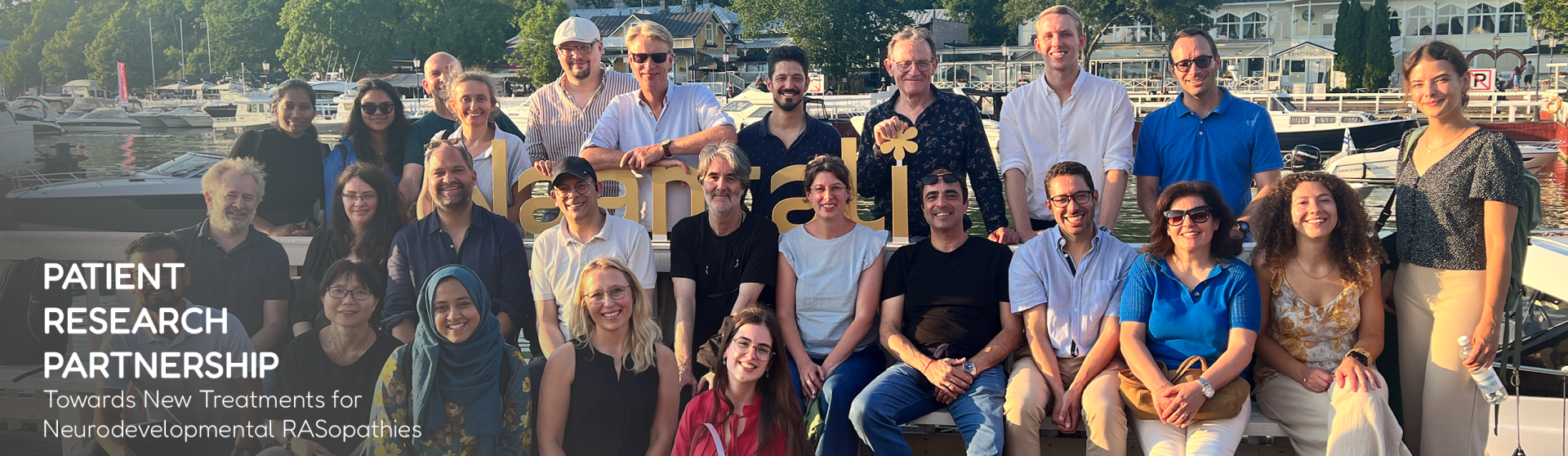
EURAS is built on collaboration.
EURAS brings together diverse expertise from stem cell biology and neuroscience to data analytics and patient advocacy to work together across eight interconnected areas of research called Work Packages. This multidisciplinary network ensures that each Work Package feeds into the next, creating a seamless pathway from research to results.
Our research follows a continuous loop from understanding disease mechanisms to validating therapies and sharing results. Each Work Package contributes a vital step toward our shared goal: developing effective therapies for neurodevelopmental RASopathies.
Work Package 1: Project management and scientific coordination
Work Package 1 will provide a clear organizational framework, guidance and all support mechanisms. It enables a smooth project workflow in EURAS and ensures the achievement in time of objectives and milestones.
Work Package 2: PATRAS: advanced bioinformatics-assisted implementation and exploitation
Work Package 2 aims to establish and exploit a PATient registry of RASopathies (PATRAS). It will create an international patient network that will be instrumental to reach, inform and recruit PATRAS participants. Advanced bioinformatics will facilitate survey design and analysis of survey datasets. Step-wise, data acquisition in six consecutive surveys allows iterative adjustment of questions in dependence on outcome of previous survey.
Work Package 3: Generation and validation of disease models
Work Package 3 will provide all EURAS partners with standardized human cell lines and mouse models for disease modelling of RASopathies and drug screens. It will also generate new cell lines to cover phenotypic variability of SYNGAP1 for disease modelling.
Work Package 4: Analysis of disease models to identify and evaluate “disease signatures”
Work Package 4 utilises human in vitro and mouse in vivo disease models to identify disease-linked phenotypes that will be used as biomarkers for drug screening in Work Package 5 and for evaluation of treatment effects in Work Package 7. Furthermore, it explores variability of identified SYNGAP1 phenotypes in iPSC lines from phenotypically segregating SYNGAP1 patients selected and generated in Work Package 2 and Work Package 3.
- Centre national de la recherche scientifique CNRS
- Universitätsklinikum Erlangen
- Max-Planck-Gesellschaft zur Förderung der Wissenschaften e. V.
- Universidad de Malaga
- IST-ID Associação do Instituto Superior Tecnico para a Investigação e o Desenvolvimento
- Universität Ulm
- Turun Yliopisto
- Erasmus Universitair Medisch Centrum Rotterdam
- AIT Austrian Institute of Technology GmbH
- The University of Edinburgh
Work Package 5: Phenotype-based drug screening and ASO development
Work Package 5 identifies effective ASOs and at least 10 repurposed drug candidates that restore, at least in part, healthy phenotypes in disease models of RASopathies.
Work Package 6: New technologies for brain delivery of statins and ASOs
Work Package 6 develops and validates novel technologies for brain delivery of drugs and ASOs with restricted permeability across the blood-brain barrier (BBB).
Work Package 7: Evaluation of treatment success
Work Package 7 determines effects of treatments on main disease-linked phenotypes, i. e. cognition, epilepsy, sleep and behaviour. This will be done on several levels: PATRAS will evaluate patient-reported outcomes of trail medication. In vitro and in vivo models will be utilised to test outcomes of treatments. Genetic determinants of treatment effect stratification and the molecular and cellular correlates of treatment success will be analysed in a multidisciplinary approach to provide a comprehensive understanding of underlying mechanisms.
- Max-Planck-Gesellschaft zur Förderung der Wissenschaften e. V.
- Universitätsklinikum Erlangen
- Paracelsus Medizinische Privatuniversität Salzburg – Privatstiftung
- Otto-Von-Guericke-Universität Magdeburg
- Universidad De Malaga
- IST-ID Associação do Instituto Superior Tecnico para a Investigação e o Desenvolvimento
- Universität Ulm
- Centre national de la recherche scientifique CNRS
- Turun Yliopisto
- Erasmus Universitair Medisch Centrum Rotterdam
- AIT Austrian Institute of Technology GmbH
- Ruprecht-Karls-Universität Heidelberg
- Neuway Pharma GmbH
- The University of Edinburgh
Work Package 8: Innovation management & patient engagement
Work Package 8 is responsible for “Innovation management & patient engagement”. Innovation management will follow a multidimensional, integrated and impact-oriented approach. It will ensure consistent communication and dissemination, optimal visibility and a wide outreach to stakeholders. Strategic planning and implementation of exploitation will safeguard that the high-quality results are captured, assessed and used. A proper IP management strategy will lay the foundation for further exploitation and sustainability activities considering background knowledge of beneficiaries and newly created results.